
ADAS Sensors
ADAS Sensors
VBOX ADAS sensors are designed as Euro NCAP and UNECE compliant validation tools, providing accurate detection of audio, visual, and physical interaction events during compliance testing.
They can log warning signals, capture door open and close status, and measure handle force, while integrating seamlessly with existing data logging systems. This helps reduce validation time, ensures reliable event capture, and offers a cost-effective alternative to complex HMI monitoring solutions without compromising accuracy or compliance.
Technical Specifications
ADAS Sensors

ADAS Sensors are advanced sensing systems designed to deliver accurate environmental perception for modern driver assistance applications. They integrate multiple technologies such as radar, LiDAR, cameras, and ultrasonic sensors to provide precise detection of objects, distance, speed, and lane positioning.
With high data processing capabilities and real-time response, these sensors ensure reliable performance in various driving conditions. Their robust design, high resolution, and seamless integration with vehicle control systems make them essential for ADAS, autonomous driving, and safety-critical automotive applications.
Key Features
- Accurate detection of audio, visual, and physical interaction events during ADAS testing
- Euro NCAP and UNECE compliant validation tools for industry-standard testing
- Logging of warning signals including audio and visual alerts
- Ability to capture door open and close status for validation scenarios
- Measurement of physical interactions such as handle force
- Seamless integration with existing VBOX and third-party data logging systems
- Reduces validation time with efficient and automated event capture
- Reliable and precise event detection for ADAS compliance testing
- Cost-effective alternative to complex HMI monitoring solutions
- Supports validation of multiple ADAS functions such as FCW, AEB, LDW and more
Applications
- Advanced ADAS solutions for enhanced vehicle safety and driver assistance
- Autonomous and semi-autonomous vehicle technology development and validation
- Real-time collision detection and accident avoidance systems
- Lane departure warning and lane keeping assist solutions
- Adaptive cruise control with intelligent traffic monitoring
- Smart parking assistance and obstacle detection technologies
- Blind spot detection for improved driver awareness and safety
- End-to-end automotive R&D and vehicle technology development
- Real-world driving data collection and validation services
- Sensor fusion using camera, radar, LiDAR, and GPS technologies
- AI-powered perception and decision-making systems
- Compliance testing for automotive safety and ADAS standards
- High-accuracy vehicle testing, calibration, and performance validation
- Data-driven development for next-generation mobility solutions
- Reliable testing across diverse road, traffic, and environmental conditions
VBOX Audio Sensor


Download Datasheet
The VBOX Audio Sensor is a highly accurate tool for detecting audible warnings and information functions within a test vehicle, including those used in Forward Collision Warning (FCW), Driver Status Monitoring (DSM), Seat Belt Reminder (SBR), and Safe Exit Assist scenarios.
Designed for seamless integration with VBOX data loggers and third-party driving robots, it captures warning tones with sub-3ms accuracy. The sensor is user-configurable via VBOX Test Suite to trigger on specific frequencies while filtering out environmental noise, and includes both integrated and external microphones to suit different test environments.
Features
- ≤3 ms (1σ) signal accuracy with fixed delay compensation
- Filters out background noise using configurable frequency thresholds
- Supports single or multi-frequency detection with flexible trigger logic
- Built-in and external microphones for varied environments
- Real-time CAN and 0–5 V digital outputs with latency data
- User-defined fixed delay to minimise internal variation
- Quick configuration via setup software with automatic delay handling
- Status LEDs for detection confirmation
- 5 mm mounting thread for secure in-vehicle installation
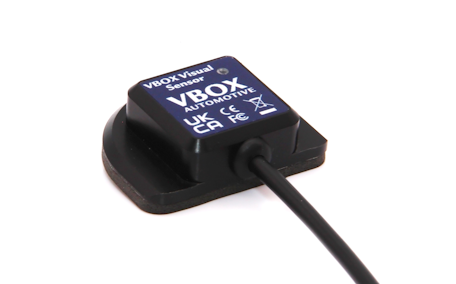
VBOX Visual Sensor


Download Datasheet
The VBOX Visual Sensor records visual alerts and information related to Forward Collision Warning, Blind Spot Monitoring, and Safe Exit Assist/ Dooring scenarios.
These visual warnings can be either sent to a VBOX for an instant pass/fail assessment based on the specific scenario, or directly transmitted to a driving robot for real-time response to the warning.
The VBOX visual sensor is one of several warning detection methods offered by VBOX to meet the requirements of UNECE, Euro NCAP, and developmental needs. It can work alongside or independently of other ADAS sensors.
Features
- Triggers the onset of a visual warning or information function given by the test vehicle
- Compatible with Pulse Width Modulated warning LEDs
- Integrated repeater LED for visual confirmation when covering the warning
- Digital output (0-5 V/ open drain compatible)
- Flange casing for easy mount on flat surfaces
Door Event Trigger Sensor


Download Datasheet
The VBOX Door Event Trigger Switch is a compact, highly responsive sensor designed for detecting vehicle door status with precision and reliability. Ideal for automotive testing and validation environments, it offers a non-invasive way to log door open/close events in real time.
The Trigger Switch is a key component of the VBOX Dooring solution, integrating seamlessly with VBOX and third-party data loggers. It provides a definitive digital signal whenever a vehicle door is opened or closed, ensuring reliable results during consumer and development testing.
Features
- Simple Integration – Installs easily between door and body with no permanent modifications.
- Digital Output – Provides a clear 0 V (closed) / supply voltage (open) signal for logging.
- Robust & Flexible – Slim, flexible design fits a wide range of door seals and geometries.
- Real-Time Feedback – Delivers instant status updates with VBOX Test Suite.
- Versatile Application – Detects door, bonnet, boot, or other panel movements.
Door Handle Force Sensor


Download Datasheet
The VBOX Door Handle Force Sensor accurately measures both the activation force and the change in force applied to vehicle door handles and operating mechanisms.
This highly sensitive sensor provides a voltage output proportional to the input force, offering invaluable data for the Euro NCAP ‘Dooring’ assessment. The measured force can be directly mapped to user-defined testing requirements such as ‘Toperate’, ‘TLatch’ and ‘Topen’.
Features
- Precise Force Measurement – Outputs voltage directly proportional to applied force for accurate analysis.
- User-Definable Thresholds – Define Toperate, Tlatch, and Topen force points for detailed Dooring evaluation.
- Simple Integration – Easily attaches to handles or mechanisms and connects to analogue inputs.
- Robust & Reliable – Durable, repeatable performance with a replaceable sensor pad.
- Real-Time Feedback – Instant results when used with VBOX Test Suite.
Application/Use Cases
Euro NCAP and UNECE compliance testing
- Audible and optical warning evaluation
- Latency measurement between control units and warning systems
- Instrument cluster and HUD alert validation
ADAS warning system validation
- Forward Collision Warning (FCW) alert detection
- Autonomous Emergency Braking (AEB) warning validation
- Lane Departure Warning (LDW) audio visual alert validation
- Speed Assist System (SAS) warning confirmation
- Post-Crash alert monitoring
Driver status and occupant monitoring systems
- Driver Monitoring System (DMS) alert compliance testing
- Seat Belt Reminder (SBR) alert verification
- Safe Exit Assist visual and acoustic warning detection
- Blind-spot monitoring alert effectiveness evaluation
Vehicle interaction and closure system validation
- Door open/close event logging for Dooring and Safe Exit Assist testing
- Door handle activation and force measurement for Euro NCAP Dooring assessments
- Bonnet, boot, and panel status detection during safety system validation
Have Questions? Get in Touch
What are ADAS sensors and why are they important?
ADAS sensors are electronic devices that enable vehicles to perceive their surroundings and support driver assistance functions. These include technologies like radar, LiDAR, cameras, and ultrasonic sensors, which are critical for safety features such as collision avoidance, lane keeping, and adaptive cruise control.
What types of ADAS sensors are commonly used in vehicles?
The main sensor types include:
- Radar: Measures distance and relative speed of objects
- Camera: Detects lanes, signs, pedestrians, and vehicles
- LiDAR: Provides high-resolution 3D environment mapping
- Ultrasonic sensors: Used for short-range detection (e.g., parking)
Each sensor has strengths, and modern vehicles use sensor fusion to combine their outputs for better accuracy.
How are ADAS sensors tested and validated?
ADAS sensors are tested using controlled scenarios with high-precision GNSS systems like VBOX, soft targets (vehicles, pedestrians), and synchronized data logging. These tests validate system performance under real-world conditions such as braking, lane changes, and obstacle detection.
What is sensor fusion in ADAS systems?
Sensor fusion is the process of combining data from multiple sensors (e.g., radar + camera + GNSS) to create a more accurate and reliable understanding of the vehicle’s environment. This improves robustness in challenging conditions like low visibility or complex traffic scenarios.
What standards or protocols are used for ADAS testing?
ADAS systems are typically validated against global safety standards such as Euro NCAP, ISO protocols, and OEM-specific test procedures. These include tests for AEB (Autonomous Emergency Braking), ACC (Adaptive Cruise Control), and VRU (Vulnerable Road Users).