
Pedal Force Sensor
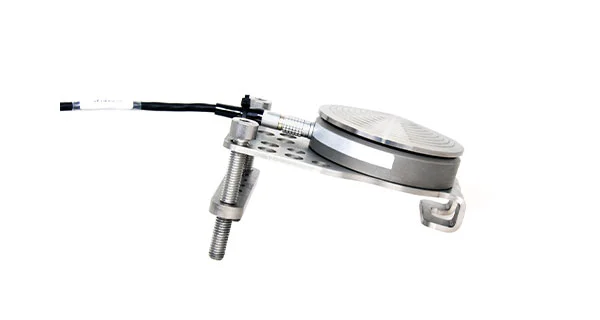
Pedal Force Sensor
Measure pedal application and force with a single sensor.
- Compliant with SAE J2909 and ECE regulation 13-H
- Measure the load applied to the accelerator or brake pedal
- Built-in strain gauge amplifier
- Optional Event Marker Interface measures pedal application
Technical Specifications
Pedal Force Sensor
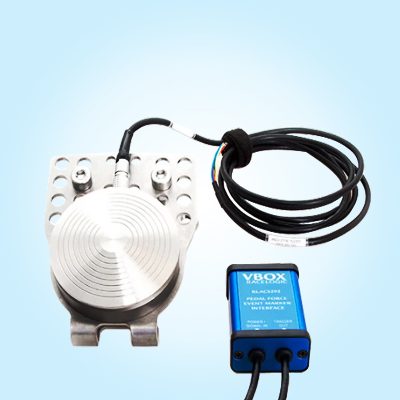
Pedal Force Sensors are high-precision measurement devices designed to accurately capture the force applied on brake and accelerator pedals. They provide real-time data acquisition with high resolution and fast response, ensuring reliable analysis of driver input and vehicle performance.
The system supports seamless integration with CAN bus and data logging platforms for synchronized measurements. With robust construction, high repeatability, and durability, Pedal Force Sensors are ideal for automotive testing, ADAS validation, and vehicle dynamics analysis.
Key Features
- Built-in strain gauge amplifier for direct analogue output without external amplifiers
- Low profile design with compact size and anti-slip contact surface
- Stable temperature compensation for consistent readings in varying conditions
- Low sensitivity to off-centre loads for reliable and accurate measurements
- Easy installation with universal mounting bracket for multiple pedal types
- Measures pedal force in compliance with SAE J2909 and ECE R13-H standards
- Measures load applied to brake, accelerator, and clutch pedals
- Optional Event Marker Interface for detecting pedal application timing
Applications
Brake and acceleration performance testing
Driver input analysis and behavior monitoring
ADAS and autonomous vehicle development
Automotive research and development (R&D)
Validation of braking systems and control algorithms
Vehicle dynamics and performance analysis
Real-world driving data collection
Integration with CAN-based systems for diagnostics
|
Measurement range
|
Overload limit
|
Measurement accuracy
|
Zero balance/ offset (%/rated output)
|
Non-Linearity (%/rated output)
|
Hysteresis (%/rated output)
|
Output range
|
|---|---|---|---|---|---|---|
|
Operating Temperature range
|
Temperature effect on zero (%/rated output/C)
|
Temperature effect on output (%/applied load/C)
|
Storage Temperature
|
Voltages
|
Current Draw
|
|---|---|---|---|---|---|
|
IP Rating
|
Material
|
Weight
|
Cell Dimensions (Diameter x H)
|
Bracket Dimensions (L x W x H)
|
|---|---|---|---|---|
The Pedal Force Event Marker Interface
As soon as any pressure is applied to the brake pedal, the interface outputs a digital signal, which can be used to trigger the start of a test. It works in a similar way to a traditional brake pedal trigger, but also allows for the measurement of pedal force and does not need to be stuck to the pedal. Instead, it can be placed next to the VBOX 4 that it is connected to, or securely inside the VBOX carry case.
This gives you a complete solution which measures the amount of force applied to a brake pedal, as well as pedal application, in accordance with SAE J2909 (Braking) and ECE R13H (Braking Assist Systems) regulations.
The VBOX Pedal Force Event Marker Interface constantly monitors the pedal force sensor voltage and adjusts the trigger threshold. This accounts for any fluctuations in pedal force caused by changes in temperature of the sensor itself, preventing incorrect trigger activation.
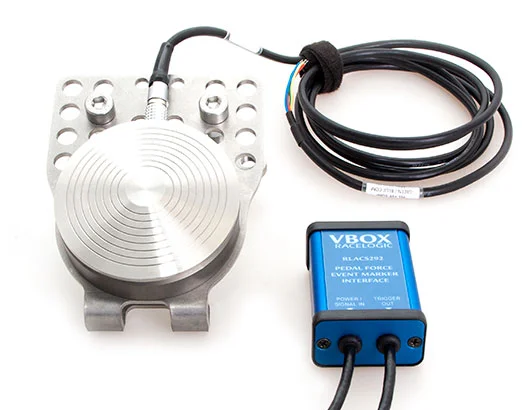
Discover more brake testing solutions
Want to learn more about brake testing? The VBOX 4 GNSS data logger is the industry standard, thanks to its impressive accuracy and range of features along with an attractive price point.
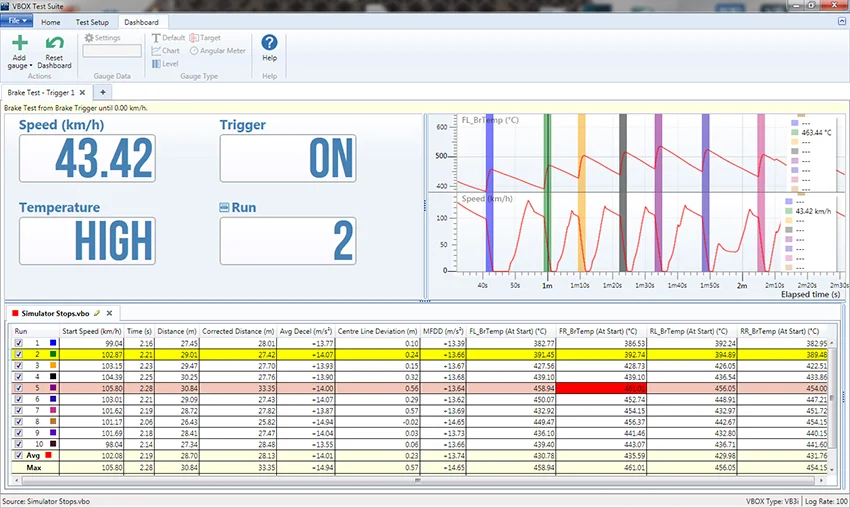
It also comes with free data analysis software with dedicated brake test plugins, making it quick and easy for you to test in real-time.
Have Questions? Get in Touch
What is a Pedal Force Sensor and what does it measure?
A Pedal Force Sensor measures the force applied by the driver on brake, accelerator, or clutch pedals. It provides accurate, real-time data on driver input, which is critical for braking performance, drivability studies, and ADAS validation.
Why is pedal force measurement important in vehicle testing?
Pedal force data helps engineers evaluate driver effort, braking efficiency, system response, and comfort. It is especially important in tests like brake performance (stopping distance), AEB validation, and pedal feel analysis.
Where are Pedal Force Sensors typically used?
Common applications include:
- Brake testing and homologation
- ADAS validation (AEB, ACC disengagement)
- Vehicle dynamics and performance testing
Human factors and ergonomics studies
How is a Pedal Force Sensor installed?
The sensor is usually mounted on or behind the pedal assembly, either as a load cell or via a mechanical fixture. Many systems are designed for quick installation without permanent modification, making them suitable for test vehicles.
Can the Pedal Force Sensor integrate with data acquisition systems?
Yes, it can output data via analog, CAN, or digital interfaces, allowing seamless integration with VBOX data loggers. This ensures synchronized recording of pedal force along with speed, position, and other vehicle parameters.